
The Shield and the Steward
A Veteran’s Vision for Bharat’s Security
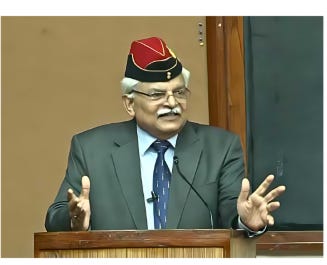
Lt Gen Vishnu Kant Chaturvedi, PVSM, AVSM, SM (Retd.)
National President, Akhil Bhartiya Poorva Sainik Seva Parishad (ABPSSP)
Q1. On Veterans and National Security
Sir, with over 30 lakh ex-servicemen in Bharat, each carrying irreplaceable operational experience, how can this community be more meaningfully integrated into our national security and internal resilience framework?
Answer:
Every ex-serviceman who hangs up his uniform does not stop being a soldier. The discipline, the situational awareness, the instinct for order under pressure, that do not retire. Bharat is sitting on an extraordinary national asset and not fully utilising it. These men can anchor our Civil Defence structures, strengthen our disaster response networks, serve as the backbone of village-level security grids in border areas, and mentor our youth in ways no civilian institution can replicate. They can be respectfully and productively deployed in non-combat roles such as NCC instruction, Sainik School administration, Border Roads Organisation supervision, disaster management coordination, community policing, critical infrastructure protection, prison security, village defence guidance in frontier zones, youth physical training, and civil defence mentorship across Bharat’s schools and institutions.
ABPSSP has been advocating precisely this, a structured, policy-backed framework that formally integrates veterans into Bharat’s security ecosystem at every level. A nation that deploys its veterans only after crises, rather than before such situations develop, is leaving its strongest shield on the shelf.
Q2. On Agnipath and Nation-Building
Sir, as a former Director General of Manpower Planning, what is your honest assessment of the Agnipath scheme, and what must the government do to ensure every returning Agniveer becomes an asset to the nation rather than a missed opportunity?
Answer:
Agnipath is one of Bharat’s boldest defence manpower reforms, firmly grounded in prior institutional thinking. The Kargil Review Committee had recommended a younger armed forces profile, and the Ajay Vikram Singh Committee report reinforced that direction structurally. The scheme’s implementation has brought the average age profile of the armed forces down from 32 years to 26 years, producing a leaner, fitter, and more technologically capable combat force. The operational rationale is sound and well-established.
Certain modifications would strengthen it further. The retention percentage should be raised from 25 to 50 percent, and the service period extended from four years to five. Hygiene factors around service conditions also need meaningful improvement. On rehabilitation, the government has rightly issued orders ensuring priority absorption of eligible Agniveers into the CAPFs, PSUs, state police, and allied institutions. These are not a rejected category. They are highly motivated, rigorously trained young men who can be a strategic asset wherever they are deployed.
The foundational architecture is in place. CAPF reservations, PSU priority recruitment, and the Seva Nidhi corpus are solid building blocks. What must now follow is binding implementation. The Agnipath service certificate must carry statutory weight across all government recruitment. Mandatory skill certification before exit must become standard practice. Every state government must honour second-career commitments without exception. A leaner force, reduced pension liability, and a pipeline of disciplined, patriotic young men entering the national economy serve Bharat’s long-term strategic and economic interests simultaneously. The political will is visible. The execution must now match it.
Q3. On the Two-Front Threat
Sir, Bharat faces simultaneous adversarial pressure from China in the north and Pakistan in the west. In your view, is our current military preparedness, structurally and doctrinally, truly ready for that two-front reality?
Answer:
The two-front reality is not a scenario Bharat plans for. It is the permanent condition we live in. We have never had the luxury of choosing our threats, and frankly, our soldiers have never waited for that luxury either. They are ready. They have always been ready. What we are still building is the structural and technological architecture that matches their courage, and that work is well underway.
Let me be direct about something that often gets lost in strategic commentary. No one comes physically to another country’s aid in the time of war. Not allies, not partners, not well-wishers. When the moment arrives, you fight with what you have built, what you have trained, and what you believe. That is the honest truth of war, and it is why self-reliance in defence is not merely a policy preference but a national survival imperative.
On the structural question, the Integrated Theatre Commands are the right direction without qualification. When your adversary fights as a unified force across domains, fighting as three separate services is a doctrinal disadvantage you cannot afford. Jointness is no longer a reform ambition. It is an operational necessity.
The transformation along the LAC, roads, tunnels, forward logistics bases, all-weather connectivity, has been remarkable. What was unthinkable a decade ago is now operational reality. The trajectory is correct, the political will is present, and Bharat’s armed forces today are better equipped, better positioned, and better connected than at any point in our independent history.
We are not merely reacting to the two-front threat anymore. We are beginning to shape the terms on which that threat must engage us. That is a meaningful strategic shift, and it deserves to be recognised as such.
Q4. On Atmanirbharta in Defence
Sir, Bharat’s defence exports are rising and indigenous systems are entering service, yet critical dependencies on foreign platforms persist. Is Atmanirbharta in defence moving fast enough for the threat environment we live in?
Answer:
Atmanirbharta in defence is the most consequential strategic decision Bharat has made in a generation, and the results are no longer aspirational. They are operational. Akash, Pinaka, Pralay, Tejas, INS Vikrant: these are not procurement achievements. They are declarations of sovereign capability, indigenous in content, indigenous in design, and increasingly competitive in the global market. The Russia-Ukraine war settled a debate that some in our strategic community were still having. A nation that cannot sustain its own weapons supply chain in a prolonged conflict is not strategically autonomous, regardless of what its alliances say on paper. That lesson has been absorbed, and Bharat’s response has been structural, not merely rhetorical.
Defence exports crossing Rs 21,000 crore is the clearest external validation. It tells the world that Bharat is no longer a defence consumer. It is a defence manufacturing power with systems credible enough for others to buy. The foundational architecture is firmly in place. iDEX, positive indigenisation lists, dedicated defence industrial corridors, and meaningful private sector integration are reforms whose impact will compound over decades. DRDO has proven it can deliver. The private sector is proving the same. Critical foreign dependencies do persist, particularly in propulsion, advanced electronics, and certain precision manufacturing domains. That is the honest assessment. But the direction is unambiguous and the momentum is irreversible.
What must continue is precisely what is already underway: sustained funding, institutional trust, and policy clarity that leaves no room for complacency. The threat environment is demanding. Bharat’s resolve is stronger. Atmanirbharta in defence is no longer a distant goal. It is a national reality in the making, and it is moving in only one direction.
Q5. On the Nation’s Debt to Its Veterans
Sir, despite OROP and various welfare schemes, many veterans, especially from the other ranks, still live without the dignity they earned. What is the one thing you want this nation to understand about what it truly owes to those who served?
Answer:
When a young man joins the Armed Forces, he does so out of passion and love for his nation. He does not negotiate, does not bargain. He willingly and voluntarily joins the forces under treacherous combat conditions. Many of us do not know that a soldier takes a pledge to serve the nation and to obey all orders to ensure the integrity of the nation is maintained, even at the cost of his life. This is probably the only service in the world where a man signs his death warrant at the beginning of his career. Therefore, a soldier, irrespective of rank, needs to be respected, given due honour, and held in the highest esteem by the nation.
The present government has done a great deal to ensure that armed forces personnel, both serving and retired, are reasonably well looked after. However, it must be ensured that their honour and dignity are protected at every level, not merely in policy but in daily practice. He simply goes. To the glacier. To the jungle. To the border. And the nation he serves has, in recent years, genuinely risen to honour that sacrifice.
OROP was a historic correction, delivered after decades of deferral. The ECHS network, Sainik School expansion, and Veer Nari welfare frameworks reflect a government that understands what it owes its soldiers. That commitment is real and it is growing.
What every citizen must understand is this. The borders that hold, the sleep you sleep at night, all of it has a price. Paid quietly and completely by men who asked for nothing but the honour of serving. The policy direction is right. What must now match it is ground-level delivery, in every pension office, every ECHS facility, every district welfare board.
The soldier served without complaint. The system must serve him without delay. That is not a welfare issue. That is the national character. And this nation, under its current leadership, is rising to meet it.


 Posts
Posts


No comments:
Post a Comment